Apartment vs Villa for Dubai Short-Term Rental: ROI (2026)
Dubai apartments average 7.1% gross yield at AED 1.3M entry; villas cost 2.8x more but command higher ADR. Discover which format fits your budget and goals.

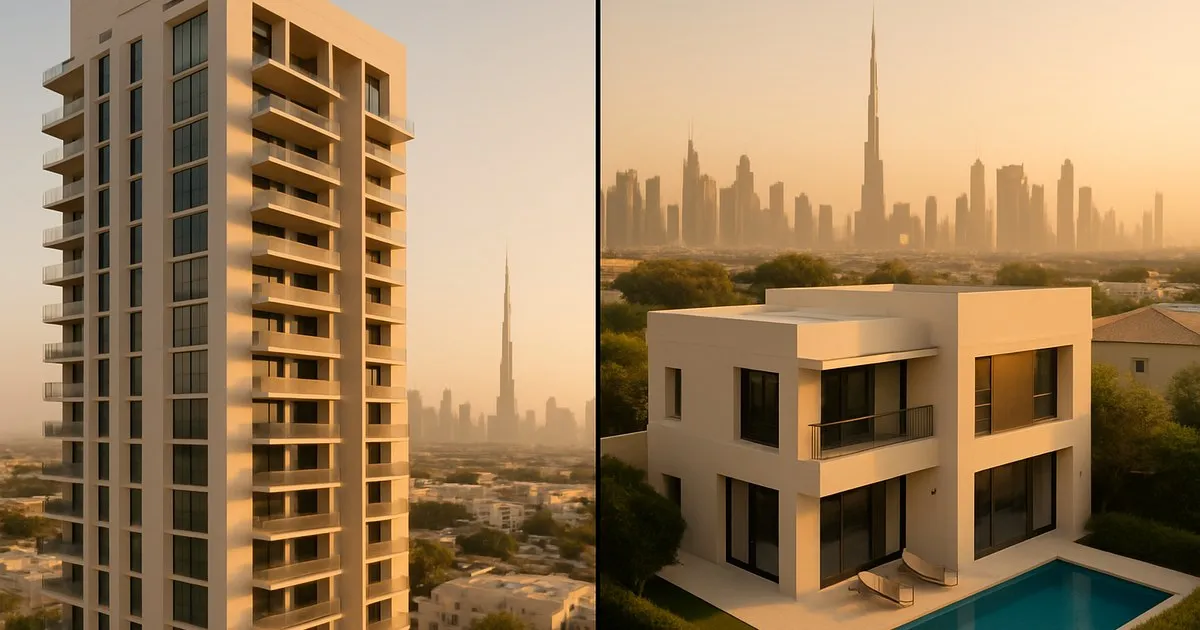
Key Takeaways
- Apartments average 7.1% gross yield at a median purchase price of AED 1.3M. Villas average 4.9–5.0% at AED 3.6M 1 2. The percentage gap narrows when you compare absolute AED revenue.
- Villas command significantly higher nightly rates — AED 1,200–2,500 for a 3-bedroom vs AED 400–800 for a 1–2 bedroom apartment — but carry AED 9,600–28,800 per year in villa-specific costs (pool and garden) that apartments don’t incur 3 4.
- Building-level NOC restrictions are the single biggest practical barrier for apartment STR. Many Dubai buildings refuse the No-Objection Certificate required by DET. Villas rarely face this gate.
- Choose an apartment if you have AED 1–2M, want faster payback, and can secure the building NOC. Choose a villa if you can deploy AED 3.5M+, target the family-travel segment, and want capital appreciation alongside rental income.
Dubai apartments deliver 7.1% gross yield. Villas deliver 5.0%. That two-point gap looks decisive until you factor in nightly rate, operating burden, and the guest segments each format can actually capture.
We work with UAE STR operators running both formats. The pattern we see: investors who compare only yield percentages buy apartments. Investors who compare absolute annual income and capital growth sometimes reach a different answer. Both groups are right, just for different portfolios.
This post compares the two formats across seven categories using current AED figures. If you haven’t seen the underlying STR cost stack, start with the Dubai holiday home net yield walkthrough. This post assumes you know what happens between gross and net.
Quick comparison: apartment vs villa at a glance
| Category | Apartment | Villa |
|---|---|---|
| Typical purchase price | AED 1.3M | AED 3.6M |
| Gross rental yield | 7.1% | 4.9–5.0% |
| Typical ADR (nightly rate) | AED 400–800 | AED 1,200–2,500 |
| DET licence fee/year | AED 1,520 | AED 3,570 |
| Furnishing cost (STR-ready) | AED 20K–55K | AED 60K–150K+ |
| Monthly DEWA | AED 700–1,200 | AED 1,200–2,000 |
| Pool + garden/month | AED 0 | AED 800–2,400 |
| Building NOC required | Yes (often refused) | Rarely an issue |
| Primary guest segment | Solo / couple / business | Families / groups |
| Capital appreciation (2025 YoY) | +9–15% | +30.7% |
Which costs less to acquire?
Apartments win on entry price by a wide margin. In 2026, the typical Dubai apartment sells for approximately AED 1.3 million, while the typical villa transacts at AED 3.61 million, roughly 2.8 times the apartment price 1.
However, the price-per-square-foot story is more nuanced. Apartments average AED 1,729 per square foot compared to AED 1,468 for villas 5. Villas cost less per square foot but cover 2.5 to 3 times more floor area, which is what pushes total acquisition cost to the 2.8× multiple. As a result, for a capital-constrained investor entering the Dubai STR market for the first time, the apartment’s lower ticket size means faster deployment and earlier cash-flow generation.
What we see in practice: most first-time STR investors in our pipeline start with a 1-bedroom apartment in the AED 800K–1.5M range. The capital barrier for villas filters the market toward investors who already own one or more rental properties and are expanding into a higher-ADR segment.
On the other hand, capital appreciation tells the opposite story. Villa prices rose 30.7% year-on-year in 2025, roughly double the 9–15% gain for apartments 1. Investors with a longer hold horizon and enough capital to absorb the entry price may recover the higher ticket through asset growth. However, capital appreciation doesn’t service your DEWA bill. Only rental income does that.
Verdict: apartments win on acquisition cost and speed to first rental income. Villas win on capital appreciation.
Which delivers higher yield?
Apartments win on percentage yield. Dubai apartments average 7.15% gross rental yield; villas average 4.9 to 5.0% 2 6. The gap is structural: it’s driven by the denominator. A villa generating AED 175,000 in annual gross revenue on a AED 3.6M purchase price yields 4.9%. An apartment generating AED 92,000 on a AED 1.3M purchase yields 7.1%. The city-wide average smooths over wide variation between areas and unit types.
Net yield after management fees, platform commissions, and operating costs compresses both numbers. Short-let apartments earn a 30 to 50% income premium over long-term rents, though net yield varies widely depending on management model, location, and occupancy 7. For the full gross-to-net cost stack, the net yield walkthrough above covers all 14 line items.
The ticket-size illusion: yield percentage answers the question “how hard is my capital working?” Absolute AED net income answers the question “how much money lands in my account?” A villa netting AED 70,000 per year beats an apartment netting AED 55,000 per year in absolute terms — but the villa deployed 2.8× the capital to get there. Which metric matters depends on whether you’re capital-constrained or return-constrained.
Area-level yields are illustrative estimates aggregated from multiple market reports 2 6. Individual properties vary; verify current area yields before purchase.
Verdict: apartments win on yield percentage. Villas can win on absolute AED income for investors with enough capital.
Which earns a higher nightly rate?
Villas win on ADR by a large margin. A 3-bedroom villa in a premium area commands AED 1,200–2,500 per night. A 1–2 bedroom apartment in Dubai Marina or Business Bay books at AED 400–800 per night 8 9. At the top end, beachfront villas on Palm Jumeirah reach AED 5,000–7,000 per night 9.
In monthly terms, a boutique villa in Jumeirah generates approximately AED 14,692 per month at 75% occupancy. A 1-bedroom apartment in Business Bay generates AED 9,183 per month 8. The villa earns 60% more per month in absolute terms. It also cost 2.8× more to buy.
Additionally, the seasonal nuance matters. Based on monthly revenue data, an estimated 55–60% of annual short-term rental income in Dubai concentrates between November and March 10. Villas are more exposed to this concentration than apartments because their guest base (families and tourist groups) travels almost exclusively in winter. Apartments serve business travellers year-round, which flattens the seasonal curve.
Verdict: villas win on nightly rate and absolute revenue. Apartments win on revenue consistency across seasons.
Which has lower operating costs?
Apartments cost substantially less to operate, both in absolute AED and as a share of revenue. The operating cost differential comes from three sources that villas carry and apartments don’t: pool maintenance, garden maintenance, and higher utility consumption.
Monthly DEWA charges run AED 700–1,200 for a 2-bedroom apartment vs AED 1,200–2,000 for a 3-bedroom villa 11. Summer air-conditioning drives the gap wider because villas cool a larger volume without district cooling, which most apartment towers provide. Pool maintenance adds AED 500–1,500 per month 3. Garden maintenance adds AED 300–900 per month 4. These villa-specific costs total AED 9,600–28,800 per year that apartment operators never see.
Similarly, furnishing tells the same story. A turnkey STR furniture package for a 1–2 bedroom apartment runs AED 20,000–55,000 12. A 3-bedroom villa requires an estimated AED 60,000–150,000 or more, based on apartment package costs scaled for larger floor area plus outdoor and pool-area furnishing. Higher replacement rates on outdoor furniture, pool towels, and garden lighting add to the villa’s furnishing burden.
As a result, service charges show an interesting inversion. Apartments pay AED 10–30 per square foot per the RERA service charge index 13, while villas pay AED 2–6 per square foot 14 15. But villas cover 2,000–4,000 square feet vs 500–1,200 for apartments. On a total-AED basis, the service charge bill lands in a similar range (AED 10,000–25,000 per year) for both formats. Villas just add pool and garden on top.
Verdict: apartments win on operating cost. Villa-specific expenses add AED 9,600–28,800 per year.
Which is easier to license?
Villas face fewer licensing barriers. The main difference isn’t the DET fee — it’s the building No-Objection Certificate.
Every apartment needs a NOC from the building’s owners’ association or management company before the Department of Economy and Tourism (DET) will issue a holiday home licence 16. Many Dubai buildings refuse this certificate. Some have blanket bans on short-term rentals written into their management rules or master development plans. If your sale-and-purchase agreement explicitly prohibits short-term letting, DET won’t issue a licence regardless of ownership 16. Newer towers built after 2020 are more likely to permit STR, but there’s no guarantee.
Villas in standalone communities rarely face NOC friction. The owner is typically the sole decision-maker. The DET licence costs more (AED 3,570 per year for villas vs AED 1,520 for apartments 16), but the extra AED 2,050 is trivial next to the risk of buying an apartment where the building blocks your licence entirely.
What we’ve observed: building NOC refusal is the most common reason Dubai apartment investors abandon their STR plans after purchase. We’ve seen operators discover the restriction only after acquiring a property marketed as “ideal for holiday home income.” Always verify NOC availability before signing.
For the full licensing walkthrough, see the DET holiday home licensing guide. For converting an existing long-term rental to short-term, the conversion guide covers the practical steps.
Verdict: villas win on licensing ease. Apartments carry NOC risk that can block the entire STR plan.
Which guest segment do they serve?
Apartments dominate the solo, couple, and business-traveller segment. Villas capture families, multi-generational groups, and luxury experiential stays. In practice, the two formats don’t compete for the same guest. They serve adjacent demand pools.
A typical apartment booking is 1–2 guests staying 3–5 nights, split roughly evenly between business and leisure. Business travellers book year-round, which is why apartment occupancy stays more consistent across seasons. A typical villa booking is 4–8 guests staying 5–14 nights, almost entirely leisure. Family-travel demand concentrates between November and March, when an estimated 55–60% of annual Dubai STR revenue is generated 10.
What does that concentration mean in practice? A villa that earns AED 20,000 per month during peak season might earn AED 6,000–8,000 during summer. By contrast, an apartment’s seasonal swing is flatter: AED 10,000 peak to AED 6,000–7,000 summer. For cash-flow planning, the apartment’s steadier income is easier to build around. For operators who can absorb seasonal volatility, the villa’s winter peak delivers outsized months.
The per-guest-night math also deserves attention. A villa at AED 2,000 per night hosting 6 guests costs each guest roughly AED 333 per night, comparable to mid-range hotel rooms. An apartment at AED 600 per night for 2 guests costs AED 300 each. Villas compete on space and privacy, not on per-head pricing.
Verdict: apartments serve the broader, year-round market. Villas win the family segment with higher total revenue per booking.
Who should choose what?
If you have AED 1–2M and want the simplest path to STR income, buy an apartment in a building that grants the NOC. You’ll get faster payback, lower operating burden, and steadier year-round bookings.
Capital-constrained first-time STR investor: apartment. Lower entry, faster payback, simpler operations. Verify the building NOC before you commit.
Experienced operator expanding a portfolio: villa. Higher absolute income, premium guest segment, minimal NOC friction. Factor in pool and garden costs.
Diversifying investor with AED 5M+: consider one of each. The apartment provides yield stability and cash-flow consistency. The villa provides ADR upside and capital appreciation. The two formats hedge each other’s weaknesses.
Edge case — NOC refusal: if your target apartment building refuses the NOC, a villa may be your only viable STR format regardless of budget. Check NOC availability before signing, not after.
For a deeper look at how Dubai neighborhoods compare for STR investment, the neighborhood guide covers area-by-area yield data. And if you’re weighing short-term vs long-term rental on the same property, the STR vs LTR comparison walks through the operator-tier math.
Verdict: category winners
| Category | Winner |
|---|---|
| Acquisition cost | Apartment |
| Yield percentage | Apartment |
| Nightly rate (ADR) | Villa |
| Operating cost | Apartment |
| Licensing ease | Villa |
| Guest segment breadth | Apartment |
| Capital appreciation | Villa |
| Overall | Depends on capital and operating model |
Apartments win four of seven categories. Villas win three. Neither format is universally better. The right choice maps to your available capital, target guest segment, and tolerance for operating complexity.
We’re building Naiteshift to handle the coordination for both formats: guest messaging, pricing, compliance, and turnover scheduling, whether you run a Marina apartment, a Jumeirah villa, or a mixed portfolio. We launch in the UAE in fall 2026.
This post was researched and written with AI assistance. All statistics are sourced from the references below. Market conditions change; verify current figures before making investment decisions.
Footnotes
-
Driven Properties, “Average House Price in Dubai For 2026,” retrieved 2026-08-31, https://www.drivenproperties.com/blog/average-house-price-in-dubai ↩ ↩2 ↩3
-
Engel & Völkers, “Average Rental Yields in Dubai – 2026 Market Insights,” retrieved 2026-08-31, https://www.engelvoelkers.com/ae/en/resources/rental-yield-dubai ↩ ↩2 ↩3
-
MEBS Facility Management, “Swimming Pool Maintenance in Dubai: Costs & Checklist,” retrieved 2026-08-31, https://www.mebsfacility.com/blog/swimming-pool-maintenance-dubai ↩ ↩2
-
Flowery UAE, “Garden Maintenance Cost in Dubai 2026,” retrieved 2026-08-31, https://floweryduae.com/garden-maintenance-cost-dubai/ ↩ ↩2
-
Engel & Völkers, “Dubai Housing Market 2026: Mid-Year Review & Outlook,” retrieved 2026-08-31, https://www.engelvoelkers.com/ae/en/resources/dubai-housing-market ↩
-
Binghatti, “Areas with Highest Rental Yield in Dubai in 2026,” retrieved 2026-08-31, https://www.binghatti.com/en/blog/highest-rental-yield-areas-dubai ↩ ↩2
-
Real Estate Club Dubai, “Dubai Short-Term Rental Guide 2026,” retrieved 2026-08-31, https://realestateclubdubai.com/blog/investment/short-term-rentals-in-dubai-det-licence-airbnb-rules-roi-guide-2026 ↩
-
Airbtics, “Annual Airbnb Revenue in Dubai 2026,” retrieved 2026-08-31, https://airbtics.com/annual-airbnb-revenue-in-dubai-united-arab-emirates/ ↩ ↩2
-
AirROI, “Dubai Airbnb Data 2026: Occupancy, Revenue & STR Market Report,” retrieved 2026-08-31, https://www.airroi.com/airbnb-data/united-arab-emirates/dubai/dubai ↩ ↩2
-
AirROI, “Dubai Airbnb Data 2026: STR Market Analysis & Stats,” retrieved 2026-08-31, https://www.airroi.com/report/world/united-arab-emirates/dubai/dubai ↩ ↩2
-
Join Oliva, “Dubai DEWA Bills 2026: Real Costs by Apt Size,” retrieved 2026-08-31, https://joinoliva.com/en/learn/blog/dewa-bills-understanding-electricity-costs ↩
-
Real Estate Club Dubai, “Furniture Packages Dubai Apartments 2026,” retrieved 2026-08-31, https://realestateclubdubai.com/blog/property-management/furniture-packages-new-dubai-apartments-2026-cost-airbnb-vs-long-let ↩
-
RERA (Real Estate Regulatory Agency), “Service Charge Index,” retrieved 2026-08-31, https://www.rera.gov.ae/ ↩
-
Luxhabitat, “Dubai Service Charges Guide 2026,” retrieved 2026-08-31, https://www.luxhabitat.ae/the-journal/dubai-service-charges-guide/ ↩
-
Driven Properties, “Service Charge Index in Dubai 2026,” retrieved 2026-08-31, https://www.drivenproperties.com/dubai-real-estate-market-guide/service-charge-index ↩
-
Property Finder, “Holiday Homes Dubai: Permits, Rules & ROI 2026,” retrieved 2026-08-31, https://www.propertyfinder.ae/blog/holiday-homes-dubai/ ↩ ↩2 ↩3
Frequently asked questions
Is a villa or apartment better for Airbnb in Dubai?
Neither format is universally better. Apartments win on yield percentage (7.1% gross vs 5.0% for villas) and entry cost (AED 1.3M vs AED 3.6M). Villas win on nightly rate, family-group bookings, and capital appreciation. Your capital, operating capacity, and target guest segment determine which format fits.
What is the ROI on a Dubai villa holiday home?
Villas average 4.9 to 5.0 percent gross rental yield, lower than apartments on a percentage basis because the purchase price is roughly 2.8 times higher. However, a well-located 3-bedroom villa can generate AED 175,000 or more in annual gross revenue, and villa capital appreciation ran 30.7 percent year-on-year in 2025. The right metric depends on whether you optimise for income yield or total return.
Can I run an apartment as a holiday home in any Dubai building?
No. DET requires a No-Objection Certificate from your building's owners association or management company before issuing a holiday home licence. Many buildings and communities ban short-term rentals through management rules or master development plans. If your sale-and-purchase agreement explicitly prohibits short-term letting, DET will not issue a licence regardless of ownership.
How much does it cost to set up a villa as a short-term rental in Dubai?
DET licence fee is AED 3,570 per year for villas. Furnishing a 3-bedroom villa for STR costs AED 60,000 to 150,000 or more. Monthly villa-specific operating costs include pool maintenance (AED 500 to 1,500), garden maintenance (AED 300 to 900), and DEWA utilities (AED 1,200 to 2,000). Total first-year setup runs AED 100,000 to 200,000 before the first guest arrives.
Do villas or apartments have higher occupancy in Dubai?
Apartments maintain steadier year-round occupancy because they serve business travellers and solo guests who book across all seasons. Villas depend more on the family-travel segment, which concentrates in November through March. During peak season, well-located villas can match or exceed apartment occupancy. During summer, the drop is sharper. Across the year, apartments typically hold a more consistent booking rate.