Multilingual Guest Communication for Dubai Airbnb Hosts
Dubai hosts 19.6M visitors yearly. Learn which languages your Airbnb guests speak, when AI translation works, and how to build a multilingual messaging system.

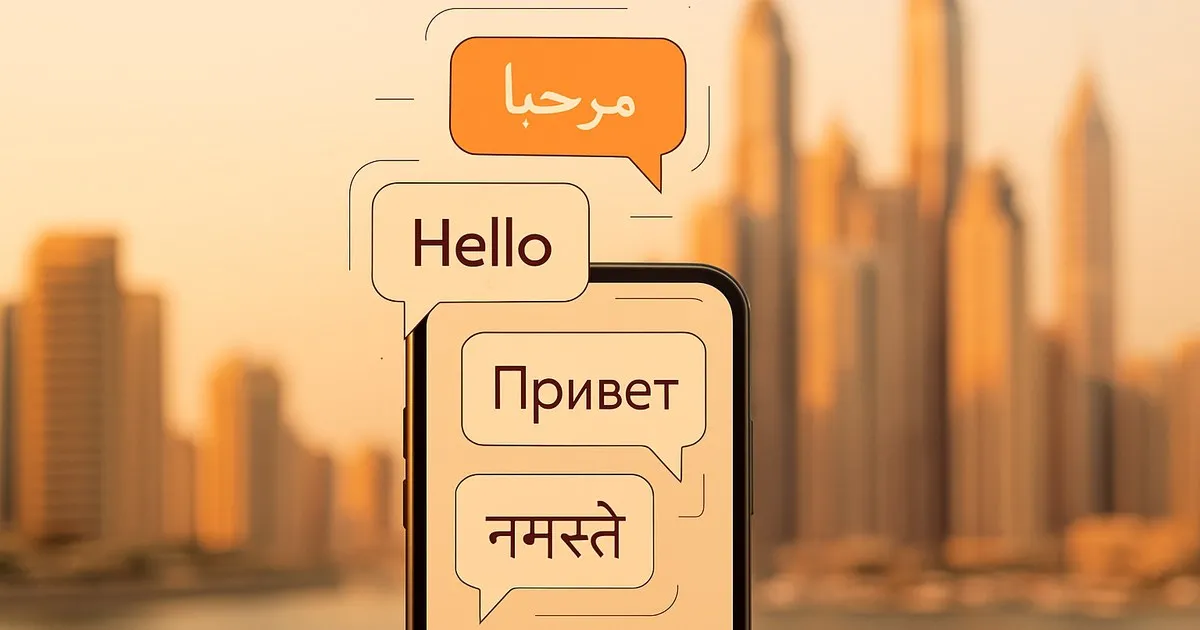
Key Takeaways
- Dubai welcomed 19.59 million international visitors in 2025, but five language groups — English, Arabic, Russian, Hindi/Urdu, and Mandarin — cover roughly 80% of STR guest communication 1.
- Pre-translated message templates handle 70–80% of guest interactions. The five must-have templates: booking confirmation, check-in instructions, house rules, checkout reminder, and local recommendations.
- AI translation handles routine hospitality messages well (directions, amenities, simple requests) but fails on tone-sensitive complaints, legal text, and cultural idioms.
- Hosts responding within one hour achieve 25% more instant bookings. The Superhost rate for sub-one-hour responders is 52.6%, versus 2.6% for hosts who take several days — a 20x gap 2.
- The practical system is three layers: templates for the predictable 80%, AI translation for the routine remainder, and human escalation for anything involving money, complaints, or safety.
Dubai welcomed 19.59 million international overnight visitors in 2025 1. Your next guest might message you in Russian. The one after that in Hindi. The check-in question at 2 AM could arrive in Arabic, Mandarin, or German.
Most hosts handle this one of two ways. They ignore the language gap and lose bookings from guests who don’t get a timely reply. Or they hire multilingual virtual assistants at AED 3,000–5,000 per month and eat into their margins.
There’s a middle path. A three-layer system — pre-translated templates, AI translation for live messages, and human escalation for high-stakes conversations — covers the vast majority of guest interactions without adding headcount. This guide walks through how to build it, starting with which languages actually matter for UAE short-term rentals.
If you’re still setting up your property, start with the full property lifecycle roadmap. Already operating? This plugs into your existing day-to-day operations workflow.
Which languages do Dubai STR guests actually speak?
In 2025, Western Europe was Dubai’s largest source market at 4.1 million visitors, or 21% of total arrivals 1. But that headline number masks the language reality. Most Western European guests communicate in English, even when it’s their second language. The language diversity comes from elsewhere.
Here’s the full regional breakdown:
Now translate those regions into the languages your inbox will see:
| Region | % of Visitors | Primary Guest Language | Notes |
|---|---|---|---|
| Western Europe | 21% | English (even from non-English countries) | UK is the largest single-country source. Germans, French, and Dutch typically message in English |
| GCC | 16% | Arabic and English | Saudi Arabia is the second-largest source country. Most GCC guests are bilingual |
| CIS / Eastern Europe | 15% | Russian | Russia is a top-5 source country. Ukrainian guests also often default to Russian for messaging |
| South Asia | 15% | English, Hindi/Urdu | India is the largest single source country globally. Many Indian guests use English but appreciate Hindi for rapport |
| MENA (non-GCC) | 11% | Arabic | Egyptian, Jordanian, and Lebanese guests — Arabic with dialect variation |
| NE / SE Asia | 9% | English, Mandarin | Chinese visitors are the fifth-largest source group. Mandarin capability adds a competitive edge |
The practical takeaway: five language groups — English, Arabic, Russian, Hindi/Urdu, and Mandarin — cover roughly 80% of your guest communication. English alone handles 50–60%, because it’s the lingua franca across Western Europe, much of South Asia, and many GCC travelers.
That doesn’t mean you can ignore the rest. It means you prioritize. Build your template library in these five first. Handle everything else with AI translation on demand.
What response time do international guests expect?
In 2025, hosts responding within one hour achieved 25% more instant bookings than slower responders 3. Speed matters on every platform. But for multilingual guests, the problem is worse: translation adds latency. A message that takes 30 seconds to read and reply to in English takes 3–5 minutes when you need to translate, compose, and verify.
That delay adds up. An estimated 75% of Airbnb host messages arrive outside traditional business hours, according to host reports 3. If a Russian-speaking guest messages at 11 PM Dubai time with a check-in question, and you don’t respond until morning because you needed to figure out what they said, you’ve lost 8 hours.
The Superhost correlation is striking. Hosts who respond within one hour hold Superhost status at a rate of 52.6%, versus 2.6% for those who take several days — a 20x gap across 92,597 analyzed listings 2. The word “responsive” now appears in 13.2% of Airbnb reviews written since January 2024, up from 9.4% historically 2.
Platform requirements vary. Airbnb expects responses within 24 hours and requires a 90% response rate for Superhost eligibility. VRBO requires responses within one hour on check-in day and during stays 3.
What does this mean for multilingual hosts? Your translation system can’t add hours to your response time. It needs to work fast enough that a guest messaging in Russian at midnight gets a reply within minutes, not the next morning. That’s the bar the template-plus-AI system needs to clear.
How to build a template library that covers 80% of messages
Templates handle the predictable slice of guest communication. Booking confirmations, check-in instructions, house rules, checkout reminders, and local recommendations follow the same structure every time. Pre-translate them once, and you’ll never scramble to compose a check-in message in Arabic at 2 AM.
Which languages to template first
DET requires emergency numbers and host contact details in both Arabic and English 4. That’s a regulatory baseline, not a suggestion. Beyond compliance, your template priority follows the visitor data: English, Arabic, Russian, Hindi/Urdu, and Mandarin.
Our observation: We’ve seen hosts in JBR and Marina handle 90% of guest queries with templates in five languages. The remaining 10% — an unexpected language, a question the templates don’t cover — is where AI translation earns its keep.
The five templates every host needs
-
Booking confirmation. Thank the guest, confirm dates, mention check-in time, ask for arrival time and any special requests. Include your contact method (WhatsApp number or platform messaging preference).
-
Check-in instructions. Building entrance directions (with a photo or map), unit number, smart lock code or key collection details, WiFi password, parking information. This is the highest-stakes template — a confused guest at the building entrance at midnight is a bad review waiting to happen.
-
House rules. Quiet hours, smoking policy, maximum occupancy, checkout procedures. Keep it short. Guests won’t read a two-page document.
-
Checkout reminder. Send the evening before departure. Checkout time, key/lock instructions, where to leave trash, request to turn off AC. One paragraph.
-
Local recommendations. Nearest grocery store, pharmacy, and restaurant. Walking directions to the metro or tram. This template is your five-star review generator.
Getting the translations right
Don’t use Google Translate for your templates. This is a one-time investment. Pay a professional translator AED 200–500 per language for the five templates — AED 1,000–2,500 total for all five languages. The cost is trivial compared to one bad review caused by a mistranslation in your check-in instructions.
Personalization tokens keep templates feeling personal. Use placeholders for the guest’s name, check-in date, check-in time, WiFi password, and lock code. Most property management systems and even a simple text-expander app can auto-fill these.
Where does AI translation actually work — and where does it embarrass you?
Most guests prefer communicating in their native language, especially when making requests or solving problems. CSA Research found that 76% of online consumers prefer purchasing products in their own language 5 — and that preference carries directly into hospitality, where unclear communication about check-in or house rules creates friction. The question is whether AI can deliver reliable translation at the speed guests expect.
The answer depends entirely on the message type. We use a three-zone framework to decide when AI translation is safe, when it needs oversight, and when you should escalate to a human.
Green zone: trust AI (70% of messages)
Routine queries where the vocabulary is narrow and the stakes are low. “Where is the nearest supermarket?” “How do I use the washing machine?” “What’s the WiFi password?” AI translation handles these reliably across most language pairs, including Arabic, Russian, and Hindi — the vocabulary is concrete, the sentences are short, and context ambiguity is minimal.
These messages share three traits: short sentences, concrete nouns, and no emotional charge. AI excels here because there’s no ambiguity to misread.
Amber zone: AI plus review (20% of messages)
Requests that carry nuance. Early check-in requests, minor complaints (“the AC isn’t cold enough”), damage reports, and questions about refund policies. AI can draft a response, but a human should read it before sending.
Why? Arabic formality levels trip up generic translators. A casual response to a formal complaint from a Saudi guest reads as dismissive. Hindi has multiple politeness registers — the wrong register can feel condescending. Russian directness, translated literally into English, often sounds rude even when the guest intends no offense. The translation is technically correct but tonally wrong.
Red zone: human only (10% of messages)
Anything involving money, legal liability, safety, or an escalated dispute. Security deposit claims, damage arguments, refund negotiations, and emergency situations. Never send an AI-translated message in these scenarios without a native speaker reviewing it.
The cost of getting a red-zone message wrong is high. A mistranslated refund refusal can trigger a platform dispute, a bad review, and potential chargeback. Spend the AED 50–100 on a professional translator or use your platform’s resolution center instead.
How to set up an AI translation workflow for guest messaging
AI-assisted translation tools cut response time dramatically — what takes 10–15 minutes with manual copy-paste translation can happen in under a minute with inline AI tools. Here’s the practical setup, from simplest to most capable.
Layer 1: platform built-in translation
Airbnb supports 62 languages across its platform for interface and listing translation 6. Message translation is not automatic — you toggle it per message using the “See original” button. Quality varies by language pair: strong for European languages, adequate for Arabic and Russian, and inconsistent for Hindi and Mandarin.
Booking.com and VRBO offer similar built-in translation. Use these as your first-pass comprehension tool. Read the guest’s message in translation. Understand the intent. Then compose your reply.
Layer 2: LLM-assisted composition
For composing replies, use a large language model rather than a phrase-by-phrase translator. ChatGPT, Claude, or Gemini all handle hospitality-register translation well. The key is the prompt.
A working prompt: “Translate the following reply to [Russian/Arabic/Hindi]. Use polite hospitality register. Keep the reply under three sentences. The guest asked about [topic].”
This produces replies that sound like a host who speaks the language, not a machine translating word by word. LLMs understand context and register in ways that Google Translate doesn’t. They’ll use the formal “you” in Russian (вы) when addressing a guest, choose the right Arabic greeting for the time of day, and match the politeness level that Hindi readers expect.
Layer 3: human escalation
Keep a short list of native speakers you can reach via WhatsApp for amber and red-zone messages. Options:
- A bilingual friend or contact — often free, but unreliable at 2 AM
- A freelance translator on Fiverr or Upwork — AED 50–150 per message, 1–4 hour turnaround
- Your platform’s resolution center — Airbnb and Booking.com both provide mediation with translation for disputes
- A concierge service — some Dubai building management offices offer multilingual guest assistance
You won’t need Layer 3 often. But when you do, having the contact ready beats scrambling mid-crisis.
UAE-specific: VoIP and messaging app constraints
In the UAE, WhatsApp and FaceTime voice and video calls are blocked under TDRA telecom regulations. Text messaging through WhatsApp works fine. For guests who need voice calls, Botim is a licensed VoIP alternative — it works reliably in the UAE and supports international calls.
Mention this in your check-in template. Guests arriving from countries where WhatsApp calling is standard will try it and get frustrated when it doesn’t connect. A proactive note (“Voice calls work through Botim in the UAE — download it before arrival”) prevents confusion.
What about guests who prefer voice calls over text?
Voice communication is rarer in STRs than in hotels, but some guest demographics default to phone calls. Older GCC travelers, some South Asian guests, and guests from countries where voice notes are the primary WhatsApp format will try to call.
The practical answer is text-first with a voice fallback. Your check-in template should include a message like: “For the fastest response, message us here or on WhatsApp. If you need to call, use Botim — voice calls through other apps aren’t available in the UAE.”
Real-time voice translation apps exist but aren’t reliable enough for guest communication. Accuracy drops significantly with background noise, accents, and the short, informal phrasing of phone conversations. They’re improving, but they’re not ready for a scenario where a guest is locked out at midnight and needs clear instructions.
For the small percentage of interactions that genuinely require voice, your Layer 3 human contacts are the fallback. A 5-minute phone call with a bilingual contact costs less than a 1-star review.
Putting it together: the three-layer system
Here’s the workflow that ties everything above into a daily operating rhythm:
-
Before your first booking: Translate your five core templates into English, Arabic, Russian, Hindi/Urdu, and Mandarin using a professional translator. Store them in your property management tool or a text-expander app.
-
When a message arrives: Read it using your platform’s built-in translation. Determine the language and the zone (green, amber, or red).
-
Green zone: Send the relevant pre-translated template, or use an LLM to compose a quick reply in the guest’s language. Send immediately.
-
Amber zone: Draft a reply using an LLM. Read the translation back in English to verify tone. If the guest sounds frustrated, add an empathetic opener. Send within 30 minutes.
-
Red zone: Draft with an LLM, then send to your native-speaker contact for review before replying. Or escalate to your platform’s resolution center. Don’t rush — accuracy matters more than speed for disputes.
This system scales linearly. Whether you manage a single property or a growing portfolio, the workflow is the same. The only variable is volume — and that’s a coordination problem, not a language problem. It’s exactly the kind of repeatable coordination that AI is replacing coordination-only agencies to handle.
If your guests also need to be registered within three hours of check-in, that’s a separate compliance workflow. See the guest registration guide and make sure your DET holiday home license is current.
We’re building Naiteshift to handle multilingual guest communication as part of a unified operations layer — one system that reads, translates, and responds across every platform your guests use, from a single unit to institutional portfolios. If you want early access, the pioneer program is where we’re onboarding operators ahead of our fall 2026 UAE launch.
This guide reflects Airbnb, Booking.com, and DET requirements as of August 2026. Platform features, translation capabilities, and regulatory requirements may change. Verify current rules with DET before making compliance decisions. This content is for informational purposes and does not constitute legal advice.
This article was drafted with AI assistance, reviewed and edited by Tom Gratz. All statistics were verified against their cited sources.
Footnotes
-
Dubai Tourism Hits Record 19.59M Visitors in 2025, Marking Third Year of Growth, Khaleej Times (2026), retrieved 2026-08-21 — https://www.khaleejtimes.com/business/dubai-tourism-hits-record-1959m-visitors-in-2025-marking-third-year-of-growth ↩ ↩2 ↩3
-
Airbnb Host Response Time Statistics (2026): 92,597 Listings Analyzed, ReziHost / Inside Airbnb (2025), retrieved 2026-08-21 — https://rezihost.com/guides/airbnb-host-response-time-statistics ↩ ↩2 ↩3
-
Response Times in Hospitality: The Vacation Rental Guide, Enso Connect (2025), retrieved 2026-08-21 — https://ensoconnect.com/resources/response-times-in-hospitality-a-guide-for-vacation-rental-professionals ↩ ↩2 ↩3
-
DET Holiday Home Regulations — property notice requirements, Department of Economy and Tourism, Dubai (see DET licensing guide for full regulatory details) ↩
-
Can’t Read, Won’t Buy — Why Language Matters, CSA Research (2020/2025 update) — https://csa-research.com/Featured-Content/For-Content-Strategists/Cant-Read-Wont-Buy ↩
-
All 62 Languages Airbnb Supports in 2026: The Full List, VirtualHost (2026), retrieved 2026-08-21 — https://virtualhost.at/blog/multi-language-guest-support.html ↩
Frequently asked questions
Do I need to speak Arabic to run a holiday home in Dubai?
No. DET requires property notices (emergency numbers, host contact details) in Arabic and English, but guest communication in Arabic is a competitive advantage, not a regulatory requirement. Most guests from GCC countries also speak English. Templates in Arabic cover the gap for the minority who prefer it.
Should I hire a multilingual virtual assistant for my holiday home?
Only if you consistently receive more than 20% of messages in non-English languages across multiple units. Below that threshold, pre-translated templates plus AI translation tools cover the workload at a fraction of the cost. A native-speaking VA makes sense for complaint escalation on a larger portfolio.
Can I use Google Translate for guest messages?
For reading inbound messages, yes — it's fast and adequate for understanding intent. For composing replies, use an LLM like ChatGPT or Claude instead. LLMs handle hospitality register, politeness levels, and cultural formality better than raw machine translation, which can produce technically correct but tonally wrong output.
How do I handle a guest complaint in a language I don't speak?
Never rely on AI translation alone for complaints. Use AI to understand the message, draft a response in the guest's language, then have a native speaker review the draft before sending. If no reviewer is available, escalate through your booking platform's resolution center, which provides its own mediation and translation.
Does Airbnb translate messages automatically?
Airbnb supports 62 languages across its platform for interface and listings. Message translation is available but not automatic — hosts toggle it per message. Quality is reliable for European language pairs but less consistent for Arabic, Hindi, and other South Asian languages. For critical messages, cross-check with a second tool.